

Hire the wrong VP and you lose six months — hire the right management consultant and you recover the six months you already lost.
What a Management Consultant Actually Delivers (And Why Technical Founders Underestimate It)
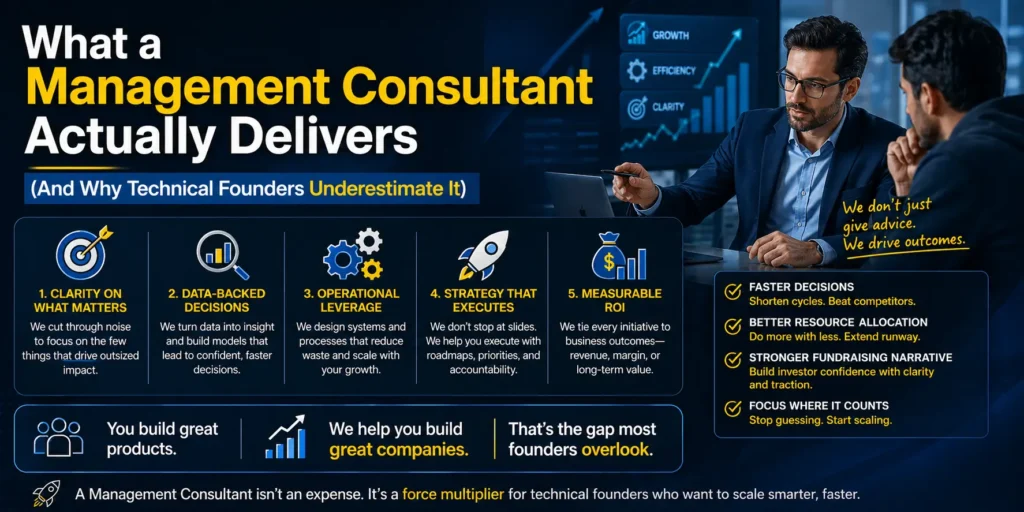
A management consultant is an external specialist who diagnoses operational, strategic, or structural problems inside a business, builds a prioritized action plan, and drives accountability through execution. That definition sounds generic until you apply it to a real situation: your customer acquisition cost climbed 40% in two quarters, your board wants an explanation by Friday, and every internal team lead has a different answer. A management consultant walks into that room with no allegiance to any of the existing narratives and finds the actual cause — usually within two weeks.
Technical founders consistently undervalue the management consultant because they conflate the role with the worst version of it: overpriced generalists who repackage your own data back to you in a nicer font. That version exists. It’s also avoidable with a 20-minute qualification conversation, which this article will equip you to run.
The structural reason a management consultant outperforms internal diagnosis comes down to three things. First, they carry no political cost for surfacing uncomfortable findings — your Head of Growth won’t tell you the growth problem starts with a broken onboarding assumption because they built that assumption. Second, they bring compressed pattern recognition from dozens of analogous companies — a management consultant who has fixed the same CAC inflation problem at seven SaaS companies in 18 months solves yours in weeks, not quarters. Third, they operate under a defined engagement window with success metrics attached, which creates accountability your internal calendar never generates.
Bain’s research on operational advisory at growth-stage companies shows businesses that bring in a management consultant during a major scaling inflection point resolve their primary bottleneck 38% faster than peers who rely solely on internal resources. For a funded startup burning $500K per month, 38% faster resolution means roughly $760,000 in preserved runway per engagement. That’s not a soft benefit — it’s a hard number you can put in a board slide.
The ROI Math on a Management Consultant Engagement (Run This Before You Sign)
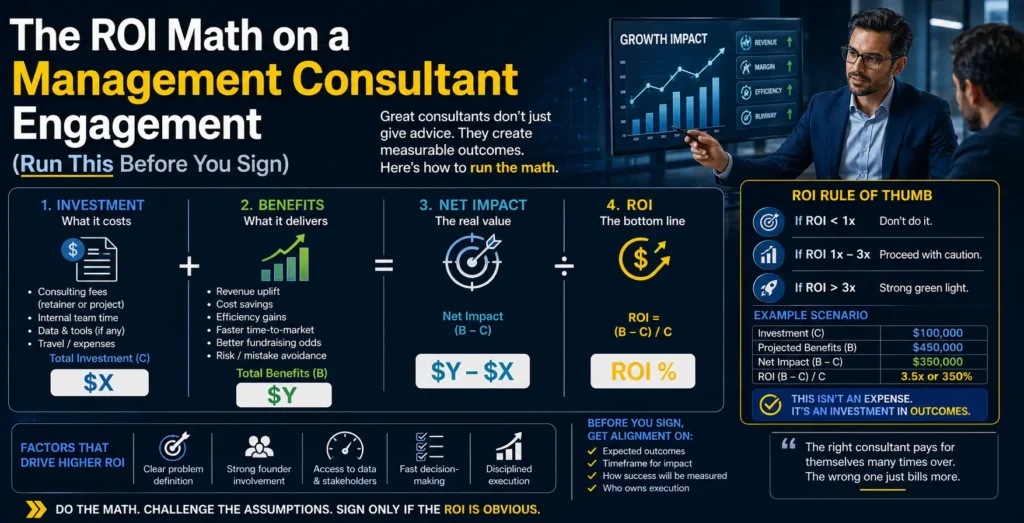
Every technical founder should stress-test a management consultant engagement against a simple three-question framework before committing budget.
Question one: What specific metric moves if this engagement succeeds? Define it numerically before kickoff — not “improve retention” but “reduce 90-day churn from 4.2% to under 2.5%.” Any management consultant who resists metric-based accountability at the proposal stage sells you a project, not a result. Walk away from that conversation.
Question two: What does one percentage point of improvement on that metric generate in annualized revenue or cost savings? For a SaaS company at $5M ARR, reducing gross churn by 1.5 percentage points generates roughly $75,000 in preserved annual revenue per cohort. Stack that across three cohorts and you recover $225,000 annually. A management consultant engagement targeting exactly that outcome and charging $40,000 for a 60-day sprint delivers a 5.6x first-year return. That math works at almost every price point in the boutique consultant tier.
Question three: What does your leadership team cost per hour, and how many of those hours does the engagement free up? A management consultant absorbs the diagnostic workload — the data pulls, stakeholder interviews, root cause analysis — that would otherwise consume 8 to 12 hours per week of your top operators’ time. At a blended leadership cost of $250 per hour, a 60-day engagement that frees 10 leadership hours per week returns $60,000 in recovered executive capacity before the consultant delivers a single recommendation. Add that to the direct revenue impact and the ROI case becomes undeniable.
BCG’s published data on SaaS pricing engagements shows companies that run a structured management consultant-led pricing audit recover an average of 15–25% in contract value previously left on the table through packaging misalignment. On $3M ARR, that’s $450,000 to $750,000 in recoverable revenue — from a single focused engagement costing a fraction of that range.
Run the math before every engagement. The number either justifies the fee or it doesn’t. A good management consultant will run it with you.
How to Hire the Right Management Consultant in 72 Hours.
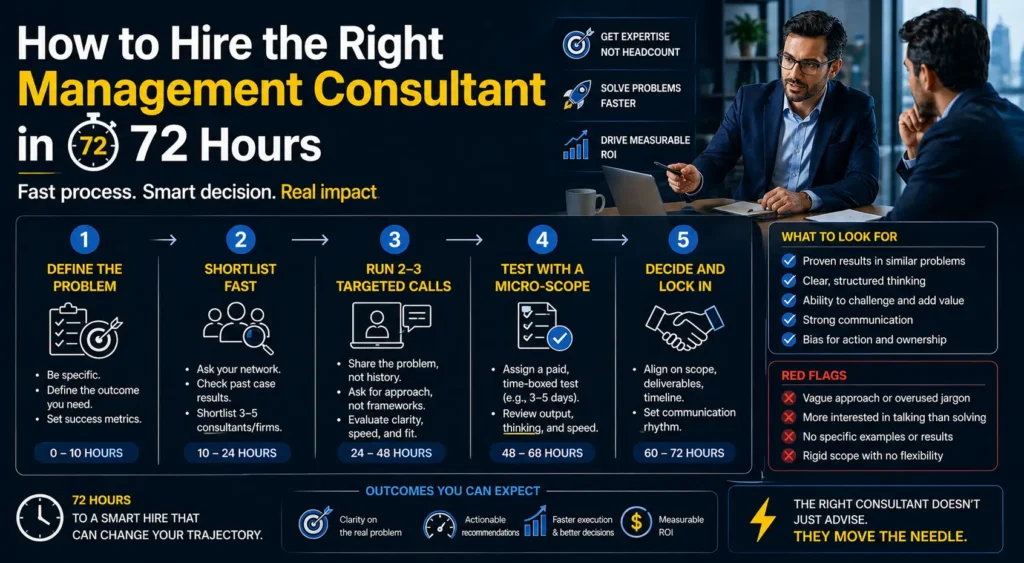
The management consultant market has three tiers, and hiring from the wrong tier for your stage is how founders waste budget and lose confidence in the model entirely.
Tier one — global strategy firms: McKinsey, BCG, Bain, and their equivalents dominate enterprise transformation programs with 18-month timelines and eight-figure budgets. At a growth-stage tech company, you pay senior partner rates for an engagement team where the partner sells and a 26-year-old analyst delivers. The pattern recognition you need doesn’t live with someone who graduated two years ago. Unless your board mandates the brand name for optics, skip this tier.
Tier two — boutique specialist firms and independent operators: This tier generates the highest ROI for technical founders. A management consultant who spent a decade as VP of Revenue Operations at three B2B SaaS companies before launching an independent practice brings exactly the compressed operational experience worth paying for. They charge $15,000–$50,000 per month, they execute the work personally, and their reputation depends on measurable outcomes — not on selling the next phase of the engagement. Prioritize this tier for any operational, GTM, or org design challenge.
Tier three — fractional embedded operators: A management consultant operating in this model commits 10–15 hours per week inside your operating rhythm for 4–6 months. They attend your leadership reviews, challenge assumptions live, and hold a specific strategic thread across a sustained scaling challenge. Cost runs $8,000–$15,000 per month. This model works best when your constraint spans multiple workstreams over an extended window — restructuring your sales org while entering a new vertical, for example.
Disqualify any management consultant candidate fast with one question in the first conversation: “Tell me about a specific engagement where your core recommendation failed to move the target metric — and walk me through how you adapted.” Operators have failure stories, adaptation narratives, and specific outcome data. Presenters have case studies and frameworks. You want the operator. Every time.
Andreessen Horowitz’s 2022 operator platform report found that founders who engaged vertical-specific management consultants — operators with direct experience in the founder’s industry — resolved their primary operational constraint 40% faster than founders who used generalist strategy firms. Specialization isn’t a preference. It’s a measurable performance variable.
The Three Engagement Structures That Work — Ranked by Speed-to-ROI
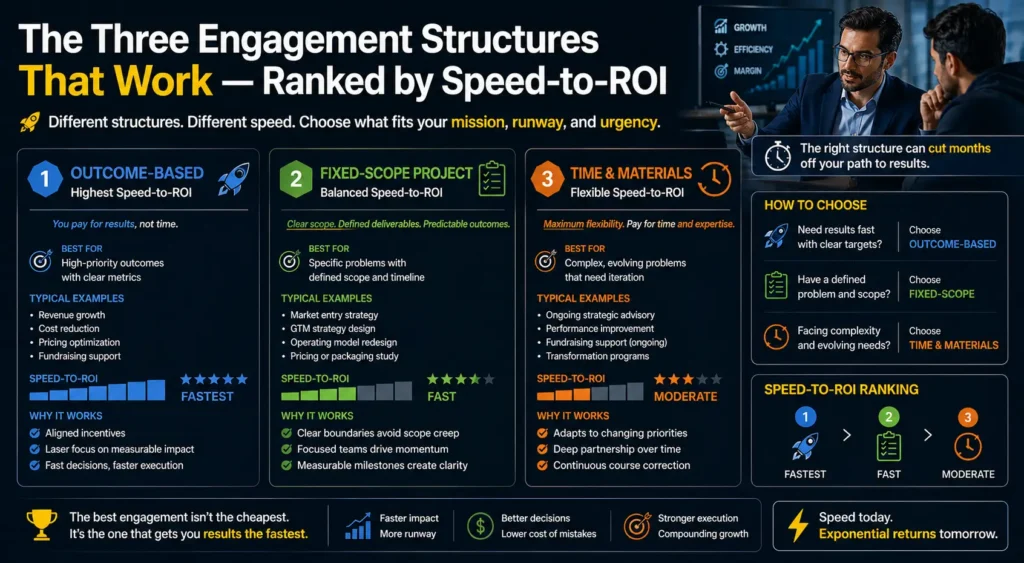
Structure one — the focused diagnostic sprint: A management consultant embeds for 30–60 days, audits one operational domain with precision, and delivers a prioritized action plan with named owners and 30/60/90-day milestones. This structure generates the fastest time-to-ROI of the three models because scope stays tight and accountability is binary — the metric moved or it didn’t. Stripe used focused operational sprints repeatedly in their pre-Series B period; Patrick Collison has cited external operational input as a direct influence on the developer experience investments that became Stripe’s most durable competitive advantage.
Structure two — the project-based fixed engagement: Fixed scope, fixed deliverable, fixed timeline. You hire a management consultant to build your customer success playbook, restructure your sales compensation model, or architect your pricing tiers. You define the success criteria before work begins. You evaluate the output against those criteria when the engagement ends. This structure gives you the most predictable cost-to-value ratio of any model.
Structure three — the fractional embedded model: A management consultant commits regular weekly hours across a multi-month scaling phase, participates in your operating cadence, and holds strategic continuity across two or more parallel workstreams. This model works when you face a sustained, multi-dimensional challenge — not a single discrete problem. It costs more in aggregate but amortizes well across a complex period.
One structure consistently destroys value: the open-ended monthly retainer with no defined deliverables. “Ongoing strategic advisory” without locked success metrics becomes a recurring line item with no accountable output. Avoid it unless you define specific deliverables, measurable KPIs, and a hard end date at the start.
Feed every management consultant you hire your real operational data from day one — actual churn by cohort, CAC by channel, NPS by segment, pipeline conversion by ICP tier. Founders who protect their real numbers from an incoming management consultant consistently report the weakest engagement outcomes. You hired them to diagnose accurately. Hand them the full chart.
The Management Consultant Who Starts Now Solves the Problem You Can Still Afford to Solve
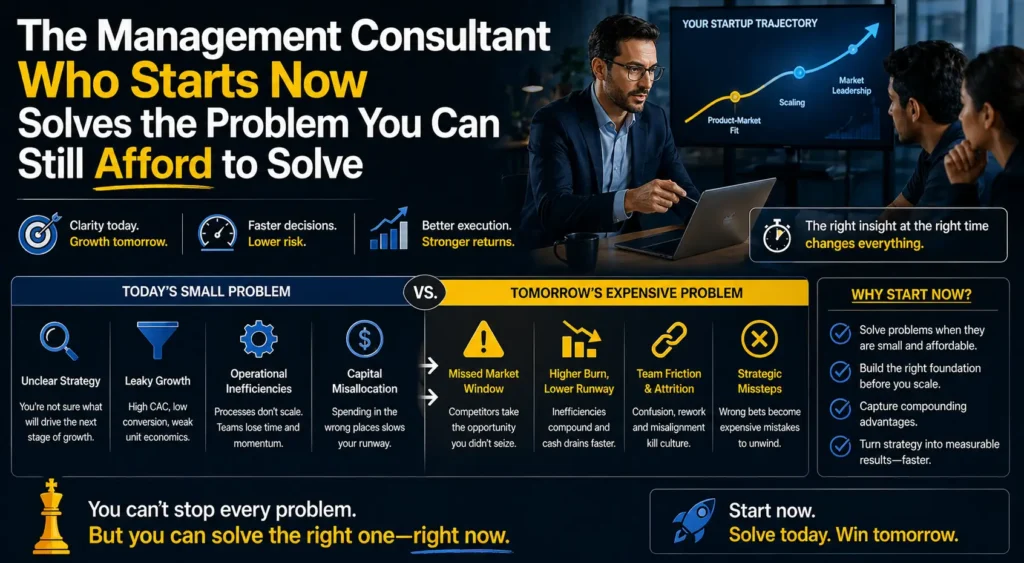
McKinsey’s research on proactive versus reactive advisory shows companies that engage a management consultant before a critical inflection compresses resolution time to an average of 11 weeks — companies entering the same engagement mid-crisis average 19 weeks. Your constraints are visible right now, your runway is still intact, and a management consultant engaged at this moment builds the operational infrastructure that eliminates the next three fires before they ignite.
Written by thesalkam.com
Pingback: Management Consultant: The Strategic Operator Behind High-Growth Companies. – thesalkam